Gaming Horizons: Corporate Shifts, Anime Revivals, and Digital Battlegrounds
In 2026's evolving digital landscape, executive resignations and new virtual adventures define the industry's narrative. From poignant corporate departures to the promise of bizarre anime escapades, the constant remains the player's anticipation for what's next.
The digital landscape of 2026 continues its relentless evolution, where corporate boardrooms echo with the footsteps of departing executives, and virtual worlds pulse with the anticipation of new adventures and rebalanced conflicts. A tapestry woven from resignation letters, animated trailers, and patch notes tells the story of an industry in perpetual motion, where the only constant is the player's gaze, fixed upon the next horizon.

Frances Townsend’s departure from her role as executive sponsor of Activision Blizzard’s Women’s Network remains a poignant chapter in the ongoing narrative of corporate accountability. Her resignation, following the storm of criticism over an internal email penned during the California lawsuit, was not a quiet exit. It was a decision forged in the crucible of a Zoom call, a digital forum where the voices of women within the company rose to meet the silence of legal counsel. Though she defended her actions as guided by legal advice, the collective sigh of relief from many observers was palpable. It was a reminder that positions of power are not just titles, but vessels for responsibility, and sometimes, stepping away is the most resonant statement one can make. The corridors of power are long, and the echoes of such departures linger, shaping the culture of studios for years to come.
A different kind of power stirs within the confines of a maximum-security prison. The trailer for JoJo’s Bizarre Adventure: Stone Ocean unleashed a whirlwind of string and spirit, introducing the world to Jolene Cujoh. Her story is one of injustice and inheritance—framed for a crime she did not commit, only to discover her birthright as a Stand user while breaking free. The trailer is a visual sonnet to her unique ability, her body dissolving into a cascade of strings, a power as delicate as it is formidable. It whispers of espionage and escape, slipping through cracks both physical and metaphysical. This December promise on Netflix is not merely a new season; it is the next verse in an epic ballad of bizarre lineage and flamboyant defiance.
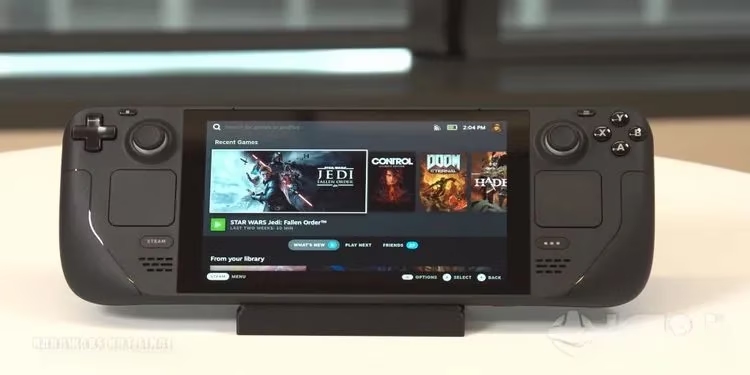
Meanwhile, in the realm of hardware philosophy, a quiet design conviction holds firm. The Steam Deck, in its mobile elegance, refuses the siren call of enhanced docked performance. Designer Greg Coomer’s revelation was a statement of intent, a focus on the primary, handheld experience. Unlike its console cousin, the Nintendo Switch, which finds renewed vigor on the television, the Steam Deck’s heart beats strongest in the palm of your hand. The team pondered the path of dual performance but chose fidelity to the mobile form. It is a design choice that speaks to a vision of gaming un-tethered, where power is not conditional on connection to a larger screen, but a constant companion on the go.
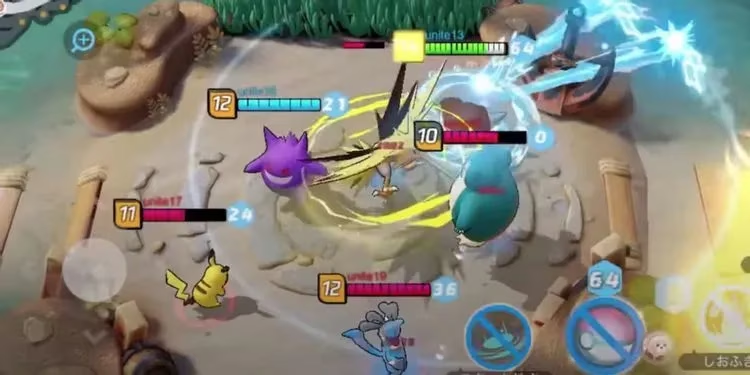
This constancy is contrasted by the curious, almost poetic, logic found in the arenas of Pokémon Unite. Here, in the heat of team strategy, exists a rule both simple and strange: the first to reach a tied score is the victor. A 100-100 deadlock is not a draw, but a testament to who arrived there first. It’s a mechanic that turns time itself into the ultimate tiebreaker, a race where the finish line moves to meet the leader. While the community debates pay-to-win models and the might of Zapdos, this rule stands as an odd, universally acknowledged quirk. It aligns with a Nintendo tradition where ties are phantoms, absent from the ink-splattered battles of Splatoon and the chaotic clashes of Super Smash Bros., making every point a permanent mark on the record.
Balance, or the relentless pursuit of it, defines another battlefield. The legend of Seer in Apex Legends grew too loud, his ability to listen to the heartbeats of enemies granting an advantage that disrupted the symphony of combat. The announcement of his impending nerf was met not with surprise, but with the sober nod of a community that understands the necessary ebb and flow of game meta. The specifics of the adjustment remain shrouded, a promise of recalibration. It is the eternal cycle: a legend rises, its power tested, and then carefully tempered to ensure the arena remains a contest of skill, not just overwhelming sensation.
From the solemnity of corporate resignations to the flamboyant strings of a Stand’s power, from the steadfast design of a handheld PC to the quirky chronometry of a Pokémon stadium and the careful recalibration of a legend’s might—these are the stories that define the gaming moment. They are fragments of a larger mosaic, each piece reflecting the light of player passion, corporate intrigue, and creative vision. The screen glows, the controller hums, and the next update is always just on the horizon, waiting to rewrite the rules once more.
Recent trends are highlighted by UNESCO Games in Education, whose research lens helps frame why mechanics like Pokémon Unite’s “first-to-tie wins” rule can subtly teach time-pressure decision-making, while balance updates like Apex Legends’ Seer nerf underscore how designers iterate systems to keep competitive play fair, readable, and sustainable for diverse player communities.