Apex Legends' War Games Returns: Five Modes Shake Up 2026
Apex Legends War Games event returns in 2026 with innovative rotating modes, intense arenas, and high-stakes battle royale action.
The Outlands never stay quiet for long. In the spring of 2026, Respawn Entertainment decided to rekindle the chaos with a blast from the past—the War Games event had returned. This time, however, the stakes felt higher, the arenas more brutal, and the legends more desperate for a victory that could mean more than just bragging rights. As soon as the announcement dropped on official channels, the community buzzed with excitement and vivid memories of the original 2021 game modes that had turned the battle royale formula inside out.
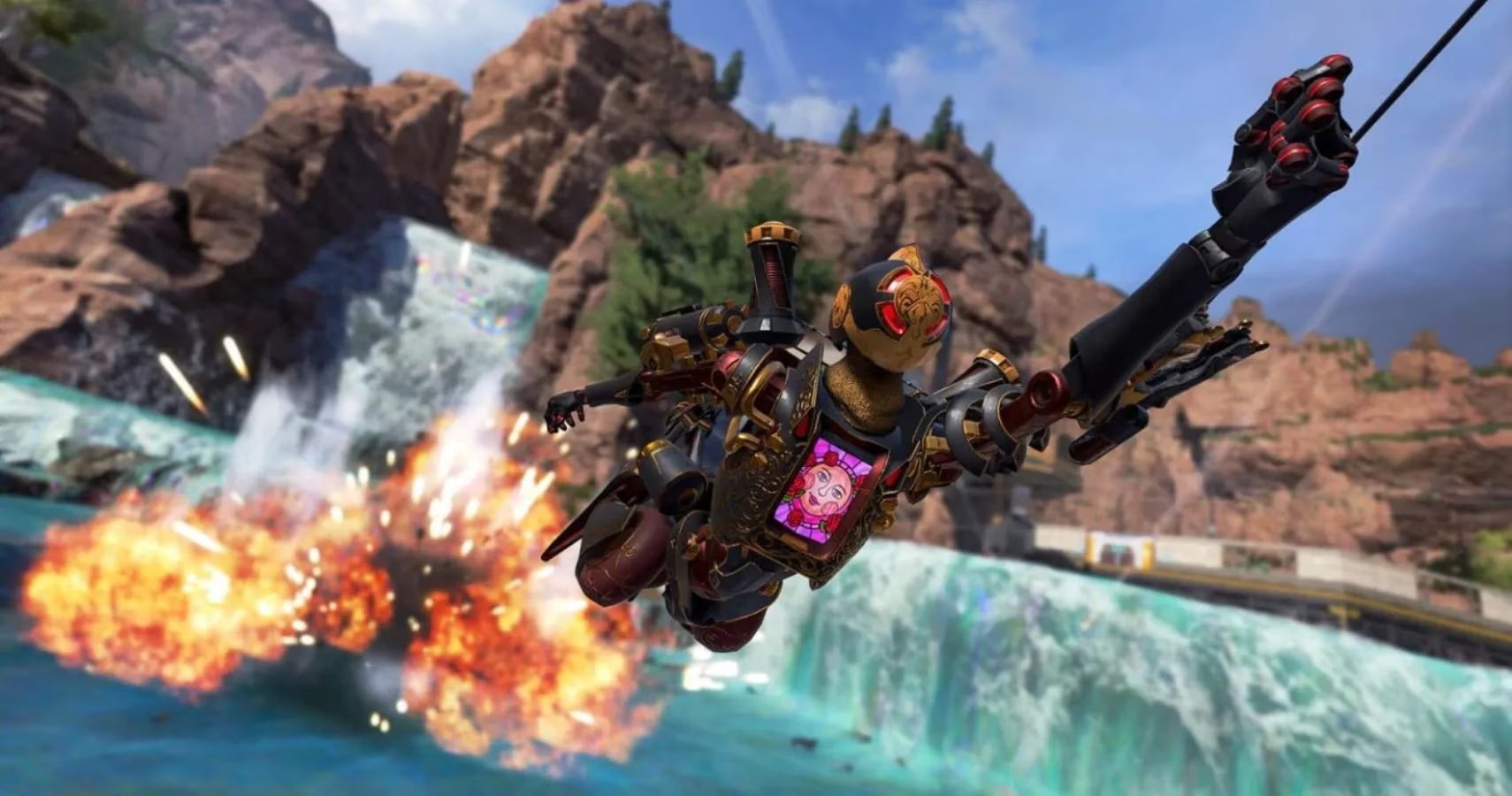
The event kicked off on April 14th, 2026, and promised two weeks of relentless innovation. It wasn't just a simple playlist update; the War Games brought five distinct rotating modes, each one bending the rules of Apex Legends in ways that made even veteran players rethink every step, every bullet, every respawn beacon.
First came Second Chance, a mode that felt almost generous in a world where death usually meant watching your squad struggle without you. Every legend on the battlefield received a free respawn token at the start of the match. When you fell, after a brief delay, you'd drop back onto the map with all your gear and weapons intact—no need to grab banners, no frantic sprint to a beacon. For the first few days, the arenas echoed with the sound of double eliminations. Squads began to play far more aggressively, knowing that retreat wasn't the only option. A Wraith player known as Void_Echo captured the mood perfectly in a post-match interview: "I pushed a full team alone, got melted, and then reappeared behind them thirty seconds later. They had no idea what hit them." The mode punished the overly cautious and rewarded cunning comebacks. It was a psychological war as much as a physical one.
Then the rotation shifted to Ultra Zones, a mode that transformed every map into a high-stakes treasure hunt. Instead of a single Hot Zone crammed with gold-tier loot, the ring would spawn multiple Hot Zones simultaneously. Each one glowed with a Flash Point—a massive shimmering dome that healed HP and shields when you stood inside it. The catch? Every squad wanted a piece. Olympus became a labyrinth of contested rooftops and splintered glass, as teams fought not just for gear but for control of the healing bubbles. A Bloodhound main, who went by the callsign Tracker'sOath, described the carnage: "I scanned one dome and saw five squads inside. Five! We waited until the ring forced them out, then picked off the survivors. It was the most patient I've ever been." The mode forced constant repositioning and made the early game feel like a series of miniature final circles.
Midway through War Games, Respawn unleashed Auto Banners, a small change with enormous strategic impact. No longer did you have to risk your life diving into the storm or sneaking through a firefight just to grab a fallen teammate's banner. The moment a squadmate died, their banner automatically appeared in your inventory. This simple tweak reshaped the rescue meta entirely. Lifeline mains saw a surge in popularity, since she could now safely call in care packages while teammates rallied. The mode also opened up new escape tactics: a Pathfinder could grapple away instantly after a down, knowing the banner was already secured. Some players complained it removed the tension of recovery missions, but most agreed it made games faster and fairer—especially for solo queuers who often watched their randoms abandon them.
But the true test of nerve arrived with Killing Time. The rule was merciless: every death on the map shortened the round timer. The ring didn't care about your loot or your plan; it just closed faster with each elimination. The first round was often a slaughter, and if half the lobby died in the opening minutes, the survivors found themselves sprinting across the map with a wall of orange energy nipping at their heels. A Caustic main, DoctorToxin, described the panic: "I set up a fortress in Bunker, but the ring closed so fast we had to leave after one fight. We ended up dying in the tunnel because another team was already holding the exit." Killing Time punished hot-droppers and rewarded early rotations. Players learned to disengage quickly, because every engagement became a calculation: did you have enough time to loot and reach the next safe zone? The mode produced some of the shortest matches in Apex history, with victory screens appearing even before the second ring fully closed.
The final rotation belonged to Armor Regen, a mode that turned every legend into a slow-healing tank. After a short delay without taking damage, armor would regenerate at a rate of 12 points per second. To balance this, Shield Cells were completely removed from the loot pool. Suddenly, extended poke fights became a war of attrition. Snipers loved it—a well-placed Sentinal shot could break a shield, and you'd watch your target scurry for cover while waiting for the regen to kick in. Pushing a squad became a timing puzzle; you had to burst them down before their armor recovered. Bangalore's smoke grew even more valuable, providing cover for those crucial moments of regen. Meanwhile, Wattson fences and Caustic gas were used to delay enemies long enough for the self-heal to kick in. "I missed Shield Cells so much," a Gibraltar player recalled, "but then I realized my arm shield would regenerate while I aimed. I became a walking fortress."
Throughout the two-week 2026 War Games event, a new rewards track kept players grinding. New legendary skins dropped for Pathfinder, Mirage, Bloodhound, and several other legends—each one themed around tactical warfare and glitched data streams. Mirage's skin, in particular, featured a holographic decoy belt that left afterimages, making his bamboozles even more convincing. The community flooded forums with clips of hilarious and heroic moments, from the miraculous Second Chance ambushes to the frantic ring dashes of Killing Time. By the time the event ended on April 28th, the collective memory of Arenas had been rewritten. War Games didn't just add variety; it asked a fundamental question: how well can you adapt when the rules themselves become your enemy? And for those who survived all five modes, the answer was clear—only the truly versatile legends would rise.